


MATERIAL DATABASE · HEAT TREATMENT
PWHT – Heat treatment, stress-relief annealing and materials engineering
Expertise in the heat treatment of steel and welded joints
Industrial heat treatment is an essential component of modern manufacturing, welding, and maintenance processes. It plays a crucial role in precisely adjusting the mechanical properties of metallic materials, reducing residual stresses, and supporting the operational reliability of demanding components.
This specialist portal offers comprehensive information on post-weld heat treatment (PWHT), stress-relief annealing, preheating and other thermal treatment processes.
The focus is on technical fundamentals, practice-oriented information and a comprehensive material database with material designations, material numbers, typical annealing temperatures and application areas.
Whether welding engineer, plant planner, designer, quality manager or technical buyer – here professionals will find sound information on the selection and evaluation of suitable heat treatment processes.
PWHT – What does Post Weld Heat Treatment mean?
PWHT stands for Post Weld Heat Treatment and refers to the targeted heat treatment of metallic components after welding.
During the welding process, the localized heat input creates significant temperature differences within the material. These lead to uneven expansion and contraction, which can result in residual stresses, structural changes, and local variations in hardness.
A professionally executed PWHT treatment can specifically influence these effects and help to ensure the material properties required for later operation.
Objectives of PWHT heat treatment
-
Reduction and elimination of welding-induced residual stresses
-
Adaptation of the microstructure in the weld seam and heat-affected zone
-
Reduction of unwanted hardness peaks
-
Improvement of dimensional and shape stability
-
Supporting toughness and long-term component reliability
-
Compliance with material- and component-specific regulatory requirements
The actual effect depends on the specific material, the initial structure and the treatment parameters applied.
Overview of heat treatment processes
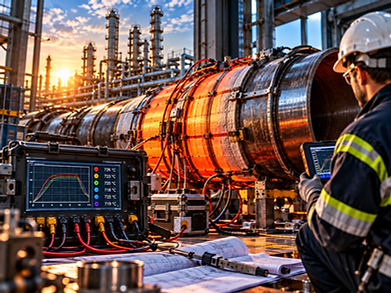
Preheating
Preheating involves bringing the material to a defined temperature before welding begins. This allows the cooling rate of the weld to be influenced and, particularly with crack-prone steels, reduces the risk of hydrogen-induced cold cracking.
The required preheating temperature depends, among other things, on the material composition, wall thickness, hydrogen input and welding conditions.

Stress-relief annealing
(Stress Relief Heat Treatment)
Stress-relief annealing is used to selectively reduce internal stresses that arise, for example, from welding, forming, machining or uneven cooling.
For this purpose, the component is heated in a controlled manner to a material-dependent temperature, held for a defined period of time and then cooled in a controlled manner.

Starting (tempering)
Tempering is used particularly for hardened and martensitic steels. By selectively heating the steel below the critical transformation temperature, its hardness, strength, and toughness are influenced.
For high-temperature resistant materials such as P91, P92 and X20, a suitable tempering treatment plays an important role in achieving the required microstructure.

Resistance annealing
In resistance annealing, heat is introduced via electrical resistance heating elements.
The process enables controlled local heat treatment, for example on pipelines, welds and tank components.

Induction annealing
Inductive heat treatment uses electromagnetic induction to heat electrically conductive materials.
It is particularly suitable for applications where targeted and easily controllable heat input is required.

Oven heat treatment
In furnace heat treatment, complete components or assemblies are heated in a suitable heat treatment furnace.
It enables controlled treatment of larger component areas and is used, among other things, in apparatus, steel and tank construction.
The process of a PWHT heat treatment
The quality of a heat treatment is not determined solely by the maximum temperature.
The entire thermal process is crucial.
1
Materials analysis and process planning
Before treatment begins, the material, delivery condition, component thickness, welding process, and applicable technical regulations are taken into account. This determines the permissible temperature ranges and other process parameters.
2
Controlled heating
The component is heated according to a defined heating rate. The aim is a suitable temperature distribution, taking the component geometry into account.
3
Reaching the treatment temperature
The required temperature is set based on material- and project-specific specifications. Depending on the material, the treatment temperatures can vary significantly.
4
Defined holding time
During the holding phase, the required temperature is maintained within the permissible range. The holding time depends in particular on the material, wall thickness, and process specifications.
5
Controlled cooling
After the holding phase is complete, the component is cooled at the prescribed rate. This limits undesirable temperature gradients and structural changes.
6
Temperature documentation and quality assurance
The relevant temperature profiles are monitored and documented according to requirements. They form an important basis for the traceability of the treatment process.
Advertisement
Your specialist for post-weld heat treatment

Do you require reliable PWHT heat treatment for welds, pipelines, tanks or industrial plants?
The team at Wärme- und Glühtechnik GRUBE GmbH supports you from the technical planning to the execution of the heat treatment on site.
Whether it's post-weld heat treatment, stress-relief annealing, preheating, resistance annealing or induction annealing – we develop a solution tailored to your project.
Request PWHT project
Speak to our specialists about the requirements of your project.
Wärme- und Glühtechnik GRUBE GmbH
Alte Ziegelei 1
48734 Reken
24-hour service – national and international


FAQ - PWHT - Frequently Asked Questions