


MOBILE HEAT TREATMENT · WORLDWIDE
On-site annealing – Mobile heat treatment
for industry and plant engineering
Precision heat treatment directly at your industrial plant
Mobile annealing technology for pipelines, welds, pressure vessels and steel structures. Understand the processes, compare materials and find specialized companies.
Glowing on site
Professional annealing technology directly on pipelines,
welds and steel structures
On-site annealing is an important part of industrial heat treatment, enabling the controlled thermal treatment of metallic components directly at their point of use. Mobile annealing technology offers significant advantages, particularly for large piping systems, permanently installed pressure vessels, power plant components, and complex steel structures.
Instead of laboriously dismantling components and transporting them to a stationary heat treatment furnace, the required heat treatment takes place directly on the construction site, within an industrial plant or during planned maintenance measures.
Methods used include electric resistance heating systems, inductive heating processes, and suitable gas-powered heating technologies. Modern measurement and control technology enables precise temperature control and documentation of the entire heat treatment process.
The PWHT specialist portal offers comprehensive information on mobile annealing, suitable processes, typical annealing temperatures, materials, technical regulations and specialized service providers.
What does "glow" mean on site?
The term "on-site annealing" refers to the performance of a controlled heat treatment directly at the location of a component or industrial plant.
Mobile heat treatment is used particularly when components cannot be treated economically or technically in a stationary furnace due to their size, weight, or fixed integration into a system.
Depending on the material and the technical task, the treatment can pursue different goals.
This includes, for example, the reduction of welding-induced residual stresses, the adaptation of the microstructure, the tempering of certain materials, or controlled heating as part of an industrial manufacturing and repair process.
Which components can be annealed on site?
-
Industrial piping and welds
-
High-pressure steam lines and boiler components
-
Pressure vessels and apparatus
-
Pipe bends, tees and pipe connections
-
Flanges and thick-walled steel components
-
Large steel structures and welded assemblies
-
Power plant and refinery components
-
Components of chemical and process plants
Not every component geometry is equally suitable for local heat treatment. Technical feasibility must be assessed based on the material, the design, and the applicable requirements.
What are the advantages of mobile glowing?

No complicated transport.
Large and permanently installed components can be treated directly at the point of use. Disassembly and transport can often be avoided.
Reduced
Downtime
Heat treatment can be integrated into existing assembly, repair and overhaul processes.
Controlled temperature management
Suitable heating and control technology enables defined heating, holding and cooling phases.
Traceable documentation
Temperature profiles can be recorded and evaluated for technical quality assurance.
Flexible
Application
Mobile heating systems can be adapted to different pipe diameters, wall thicknesses and component geometries.
Industrial applications
Suitable for numerous tasks in power plant construction, pipeline construction, tank construction and during plant shutdowns.
What processes are used for on-site annealing?
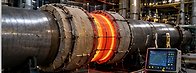
Preheating
Controlled heating of steel components before welding to reduce cold cracking and optimize cooling conditions.

Stress-relief annealing
Targeted heat treatment to reduce internal stresses in welded, formed and machined components.
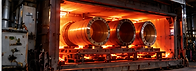
Starting
Controlled heating of hardened steels for targeted adjustment of hardness, strength and toughness.
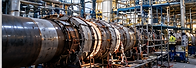
Effusion annealing
Thermal treatment to promote hydrogen diffusion and reduce hydrogen-related damage.
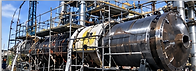
Diffusion annealing
High-temperature treatment to reduce chemical concentration differences and segregation in the material structure.
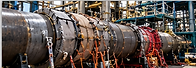
Normalize
Heating and subsequent cooling in air to produce the most uniform, fine-grained steel structure possible.
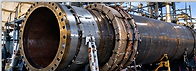
Solution annealing
Heat treatment to dissolve suitable precipitates and to achieve a defined material condition.
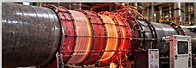
Resistance annealing
Controlled heating using electrical resistance heating elements for welds, pipelines and containers.
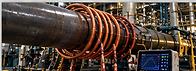
Induction annealing
Low-contact heating of metallic components through electromagnetic induction for precise heat treatment processes.

Gas glow
Heat treatment using gas-powered burner systems for targeted heating of suitable components and welding areas.
On-site stress-relief annealing –
Reduce residual stresses in a targeted manner

Stress-relief annealing is one of the most important applications of mobile heat treatment.
Significant residual stresses can arise during welding, forming, or machining of metallic components. These stresses can affect dimensional stability and, under certain operating conditions, increase the stress on a component.
In stress-relief annealing, the material is heated in a controlled manner to a defined temperature, held for a specified period of time, and then cooled at a suitable rate.
During the holding phase, internal stresses can be reduced through temperature-dependent plastic deformation and relaxation processes.
When is on-site stress-relief annealing useful?
The process is used, for example, in thick-walled welded structures, pressure vessels, piping systems and large steel components.
The necessity for such heat treatment arises from the respective material specification, the component requirements and the applicable regulations.
The correct selection of the treatment temperature is particularly important. Excessively high temperatures or unsuitable holding times can adversely affect the mechanical properties of certain materials.
PWHT on site – heat treatment after welding
PWHT stands for Post Weld Heat Treatment and describes the targeted heat treatment of a metallic component after completion of the welding work.
Depending on the material, PWHT treatment can fulfill different functions. These include the reduction of residual stresses, the adjustment of hardness, the tempering of martensitic microstructural constituents, and the adjustment of required material properties.
In industrial pipelines and permanently installed systems, heat treatment is often carried out locally in the area of the weld seam.
Typical procedure of a mobile PWHT treatment
1
2
3
4
5
6
Technical preparation
Examination of material, wall thickness, weld joint, heat treatment instructions and applicable regulations.
Installation of the heating systems
Positioning of heating elements, thermocouples and thermal insulation according to the treatment concept.
Controlled heating
Controlled heating of the component while adhering to the prescribed heating rate.
Maintaining the annealing temperature
Compliance with the required temperature and holding time within the specified tolerances.
Controlled cooling
Controlled cooling according to material and component-specific requirements.
Documentation and testing
Evaluation of the temperature profile and preparation of the required heat treatment documentation.
Materials and annealing temperatures in mobile annealing
Selecting the annealing temperature is one of the crucial steps in planning an industrial heat treatment.
Each material has specific metallurgical properties that must be taken into account when determining temperature, holding time, and heating and cooling rate.
Heat-resistant chromium-molybdenum steels
Materials such as 13CrMo4-5, 10CrMo9-10, and 16Mo3 are frequently used in boiler systems, steam lines, and pressure vessels. Depending on the application, heat treatment may be required after welding.
High-temperature-resistant martensitic steels
P91, P92, and X20 are used particularly in thermally stressed power plant components. Correct tempering treatment is of particular importance, as the microstructure significantly contributes to high-temperature strength.
Pressure vessel and fine grain steels
Materials such as P355GH, P355NH, P420NH and P460NH are used in demanding pressure vessel designs. Heat treatment must be tailored to the material's as-delivered condition and the required strength and toughness properties.
Material data for the portal link
material
13CrMo4-5
10CrMo9-10
16Mo3
P91
P92
X20CrMoV12-1
P355GH
P355NH
Material no.
1.7335
1.7380
1.5415
1.4903
1.4901
1.4922
1,0473
1.0565
Material group
Heat-resistant Cr-Mo steel
Heat-resistant Cr-Mo steel
Molybdenum alloyed steel
Martensitic 9% Cr steel
High-temperature resistant martensitic steel
Martensitic 12% Cr steel
Pressure vessel steel
fine-grain pressure vessel steel
The specific annealing temperatures should be published on the respective material detail pages, along with the relevant standards, application conditions and technical limitations.
Important: Annealing temperatures are not universally applicable settings. Actual application depends on an approved heat treatment instruction and the specific technical requirements.
Apparatus and container construction
Controlled heat treatment of large welded assemblies, pressure vessels and thick-walled components.
Pipeline construction
Mobile annealing technology for pipe welds, pipe bends, fittings and demanding piping systems.
Maintenance and plant shutdowns
Maintenance and plant shutdowns
Integration of mobile heat treatments into repair, overhaul and shutdown work.
Steel and mechanical engineering
Stress-relief annealing of large welded structures to reduce residual stresses and improve dimensional stability.
Temperature measurement, annealing protocols and quality assurance
Professional mobile heat treatment requires precise control of the entire temperature profile.
Besides the actual annealing temperature, the heating rate, holding time, temperature distribution and cooling rate are particularly important.
Temperature monitoring with thermocouples
Thermocouples are attached to suitable measuring points on the component and connected to the temperature control system.
The number and position of the measuring points depend on the component geometry, the heat treatment process and the applicable technical requirements.
Digital temperature control
Modern control devices monitor the temperature profile and control the heating power according to the specified treatment program.
This allows the necessary thermal process steps to be carried out in a controlled manner.
Glowing protocols and documentation
Depending on the project requirements, the following information can be documented:
-
Material and component identification
-
Heat treatment instructions and process parameters
-
Position of the heating and temperature measuring points
-
Heating and cooling rates
-
Glowing temperature and holding time
-
Temperature-time diagrams
-
Inspection and release notes
Comprehensible documentation supports quality assurance and technical acceptance.
Standards and technical regulations
Mobile heat treatment is carried out on the basis of material-specific specifications, technical regulations and, where applicable, qualified heat treatment instructions.
Depending on the area of application, the following regulations, among others, may be relevant:
EN 13445 – Unfired pressure vessels
Contains requirements for the design and manufacture of pressure vessels, as well as for any necessary heat treatments.
EN 13480 – Metallic industrial piping
Regulates requirements for industrial piping systems, including relevant manufacturing and testing processes.
EN 1011 – Recommendations for welding metallic materials
Provides technical recommendations for the welding of different materials.
ASME Boiler and Pressure Vessel Code
Contains requirements for numerous pressure vessel and boiler applications, including material- and design-dependent heat treatment specifications.
Applicability depends on the specific project, the component, and the contractually agreed regulations.
FAQ – Frequently Asked Questions about On-Site Glow